_edited.png)


CARNIVAL STRAUSS DYNASTY Episode Two: JOHANN II – THE GREAT
Updated: Jan 22
NLWM No 38 15/01/2026
The concept of a dynasty implies the transfer of power to a member of the family. In the Strauss dynasty, it was the other way around. Johann I forbade his children from learning music at all. Fortunately, to no avail.
Rebellious Prince
A famous father sent his son, also Johann, to a trade school to be a bank clerk. Meanwhile, the son, with the support of his mother, secretly took music lessons. At the age of 19, he organized a music band with which he started to perform his own compositions.
This was possible because his father traveled a lot. When he returned, he found himself more often in his second, informal family. He had eight children there. (In his formal family, he already had six.) Noticing that his disobedient son became a competitor, he even fought him.
Heir to the Throne
However, when his father died in 1849, his son took over his famous orchestra. He amalgamated it with his own band. He explained it modestly: 'Only to support and feed my abandoned mother and young siblings did I dare to use my modest talent...'

His career quickly eclipsed his father's. He was so popular that during the season he rushed from one concert to another. He conducted dozens of concerts a week. Especially the Carnival was a real goldmine for the Strauss family. Carnival is a joyful welcome to the New Year with hope that it will be a good year.
A Rebel, a Courtier but Never a Dancer
In 1848, the multinational Habsburg Empire was shaken by the Spring of Nations. Strauss Junior, in contrast to his father, sympathized with the revolutionaries. He played La Marseillaise and was even arrested. This later delayed his court appointments.
However, the new monarch, Franz Joseph I, had ascended the Austrian throne. He was more conciliatory to the Empire's nations as well as to individuals. Also, Junior became The Waltz King, as Strauss II, and created chances for his 'abolition'. He composed several patriotic songs, including Emperor Franz-Joseph March. As a result, he became the General Director of Imperial Court Balls.
With all this, it's funny that the Imperial Director and composer of the most famous dances and the Imperial Director of Balls never danced. He didn't learn it, and that's it!
The World at His Feet
He visited London, Berlin, Petersburg, and the USA among many others, with his orchestra. Hundreds of thousands listened to his waltzes, galops, quadrilles, and polkas. In 1872, he conducted a 1,000-musician orchestra at the World's Peace International Music Festival in Boston. At the time, it was a world record!
At that time, requests for personal mementos from celebrities were often in the form of a lock of hair. In the US, his valet obliged by taking care of Strauss's black Newfoundland dog and providing 'authentic Strauss hair' to adoring female fans.
Well-Deserved Fame
The serious musical world also recognized his talent. Johannes Brahms: Strauss was his personal friend, to whom Strauss dedicated the waltz 'Be Embraced, You Millions'. Richard Wagner once admitted that he liked the waltz 'Wein, Weib und Gesang' (Wine, Women, and Song). Richard Strauss (but not related) said in reference to Strauss: 'How could I forget the laughing genius from Vienna?!'
In addition to countless waltzes as famous as The Blue Danube, Emperor-Waltz, Tales from the Vienna Woods, Voices of Spring, and polkas (such as Trisch-Tratsch), he also composed 17 operettas, including the famous Die Fledermaus (The Bat), Night in Venice, and The Gypsy Baron.
It Is Just There to Be Enjoyed?
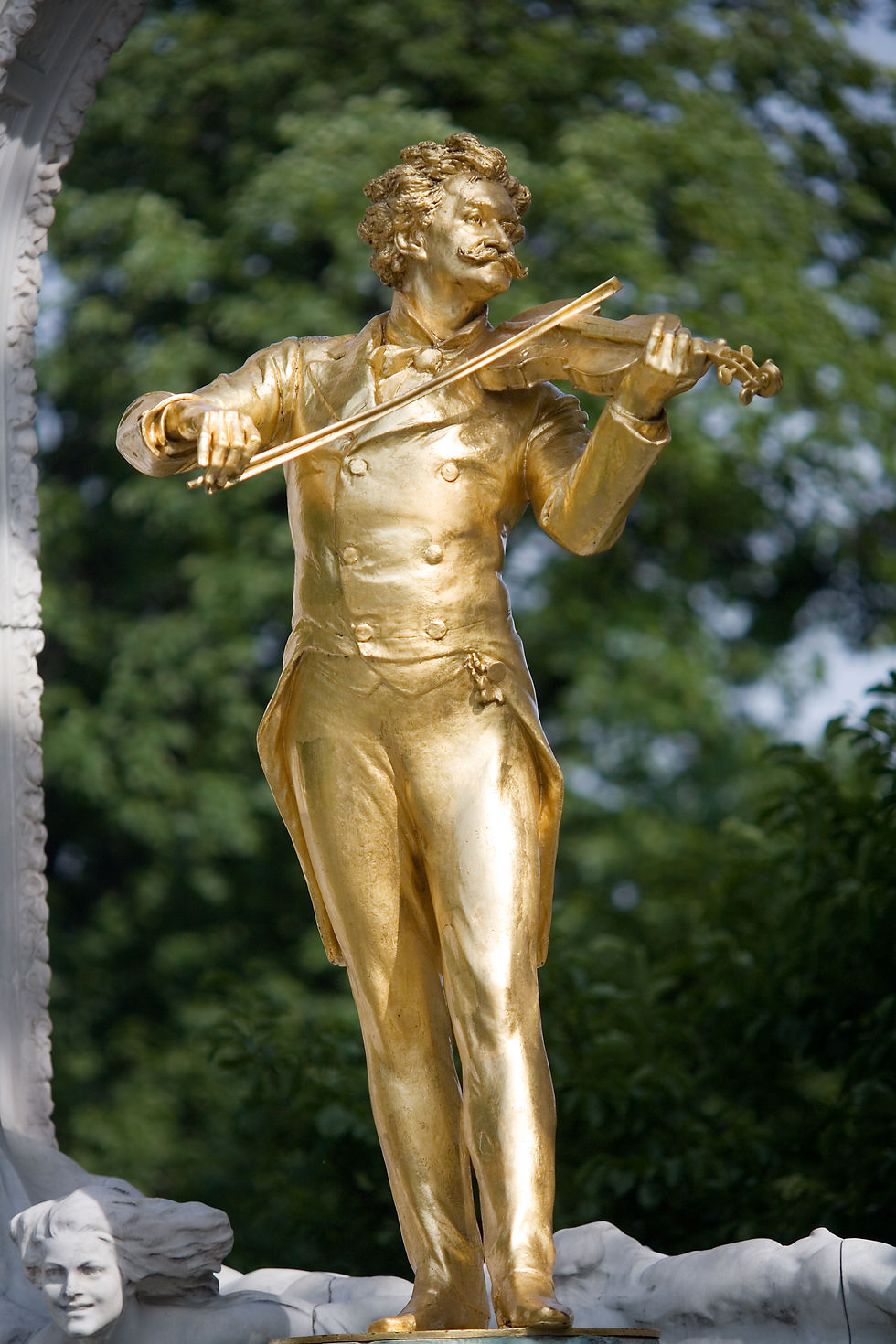
Every tourist route in Vienna leads past the famous monuments of Empress Maria Theresa (in stone) and the violin-playing Johann Strauss II in gold. Tourists most often take photos with the King of Waltz.
Behind the Footlights
Posthumous: The creator of wonderful dances couldn't dance. The man who gave so much joy to people suffered. Putting aside his married life, almost as complicated as his father's, he suffered from manic-depressive psychosis. Once, just like his father, he fell off the podium during a concert. The life of kings isn't easy either. Even the Kings of Waltz.
Enough words.
Let us play:
J. Strauss II- Voices of Spring, Op. 410
&
J. Strauss II - Trisch -ratsch Polka, Op. 214

Written by
Cezary Owerkowicz
Co-founder of Kuwait Music Academy and
Director of Treasure of Talents Festival in Kuwait


