_edited.png)


CARNIVAL STRAUSS DYNASTY Episode One: FOUNDATION
- Jan 9
- 4 min read
Updated: Jan 14
NLWM No 37 09/01/2026
Carnival is a several-week period of joy and fun. It lasts from the beginning of the year until Lent. The name comes from the Italian 'carnivale' – farewell to meat.
As you know, Dynasty is not just a title of a TV series. By definition, a dynasty is a family in which power passes from generation to generation. In the Mid-East – the Umayyad or Abbasid, in Europe - the Bourbon or Habsburg dynasties were legendary. This term is also used to refer to families with great influence in politics, business, or culture (The Kennedy, Rockefeller, and so on).
In music, the largest dynasty recorded in history seems to be the Bach dynasty. As many as 50 musicians, of course with Johann Sebastian Bach (1685-1750) at the forefront. He wrote about 1000 compositions and had twenty children with two wives. Most of them – composers. And their father is considered 'The Father of Music'. (And – musicians, of course!)
Two Dynasties In One Capital
I'd consider the second largest musical dynasty in history to be the Viennese Strauss Dynasty. Strauss in German means 'ostrich'. As we know, it is the largest bird that doesn't fly but runs very fast. In danger, it buries its head in the sand and has beautiful decorative feathers. Fits like a glove, except that: the Strauss stuck to the dance floor, but always held their heads high.
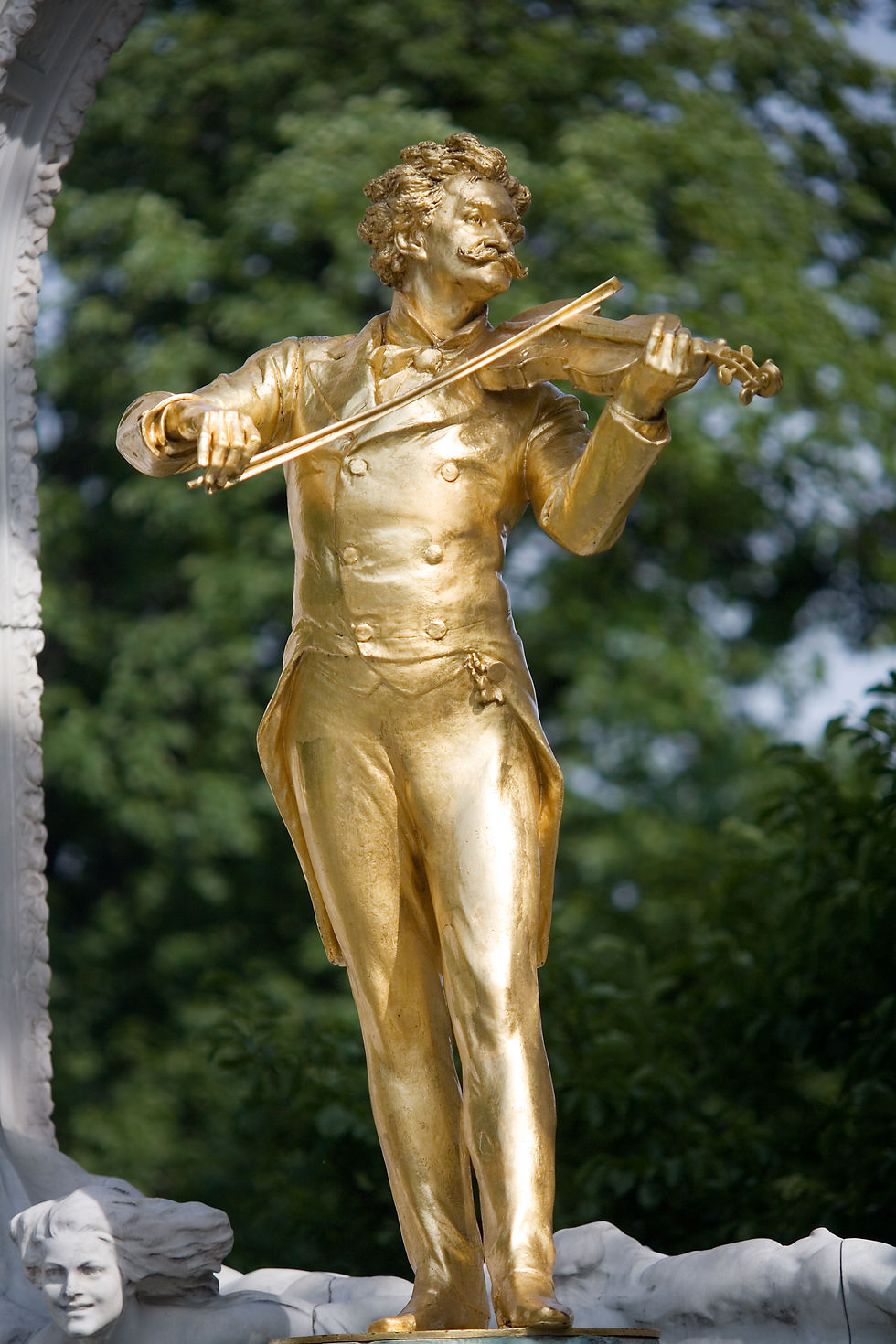
At that time, Vienna was considered one of the world capitals. It was known for two dynasties at the same time: The Habsburgs ruled from the Emperor's Palace and The Strauss, on the floors. This can be confirmed today when visiting Vienna. Each tour route leads to a stone monument of Empress Maria Theresa and a golden statue of the King of Waltzes, Johann Strauss, who is playing the violin. Most tourists take photos with Strauss!
The Birth of a Dynasty
It started in 1804, at the Leopoldstadt Inn. His parents were innkeepers. His mother passed away from 'creeping fever' when he was seven. His father soon drowned in the waves of the Danube River. The boy's guardian, the tailor Anton Muller, sent him as an apprentice to a bookbinder. The boy on the side learned to play the violin with a friend. With success, because he got into the local orchestra. Soon he left the group and joined the entertaining string quartet of the well-known in Vienna Joseph Lanner. The ensemble played Viennese Waltzes and rustic German dances. In 1824 it expanded into a small orchestra.

Johann became deputy conductor when it became popular during Fasching (Carnival) of 1824. And so the Founder of the Dynasty was born on the stage. Yes, he was called later Johann Strauss Senior or The Father. Finally – Johann Strauss I.
How to start the career?
From the beginning. He soon struck out for himself into running his own band. To his own waltzes, he gave his own rhythmic zest. Johann Strauss I began his long road of triumphs in the Carnival of 1826. He began it with his Opus 1 – Waltz of Little Doves. And at once he established his reputation. He became the best-known and most loved composer in Vienna.
In relation with Lanner, he became a victorious rival but not an enemy. It may seem strange that Strauss made no reference to the Three Great Viennese Classics: Haydn - Mozart - Beethoven. They inspired almost all European music. But the Viennese, especially those from the growing inspiring classes, wanted something lighter, more sparkling, dancing, and singing.
Waltz in Homage to the Queen
Not only Viennese! The Waltz King expanded his influence Urbi et orbi. Strauss with his ensemble toured Europe - Germany, the Netherlands, Belgium, Great Britain. Only in London did he perform 79 concerts (April-June 1838), one of them for the young Queen Victoria (May 10). A chivalrous composer wrote and performed for her in Buckingham Palace Waltz 'Hommage à la Reine d'Angleterre'. Voila! After touring Scotland and Ireland, he dreamed of expanding his conquest to – America. Health got in the way. The retreat to Europe began via Calais.
NB. In France, he encountered the quadrille, which was popular there. He enjoyed the dance so much that he added it to his regular concert menu.
Rhythm of a Waltz to The End
Strauss's admiration bordered on fanaticism. His dying lady-admirer demanded that Strauss' orchestra play at her funeral. For a very high fee, of course. And despite the family's resistance, the ceremony took place to the rhythm of the...Viennese Waltz.
Unfortunately, the composer himself soon set off on his last journey, quite early: to be only 45. He left behind hundreds of compositions as well as a wife with 6 children (among them the heir to the throne – Johann II) and a mistress with 8 children. Whether his most popular piece to this day and beyond, The Radetzky March, Op. 228 was played as a farewell to him is unknown. But I wouldn't be surprised, if any...
Enough words.
Let us play:
J. Strauss I - Radetzky March, Op. 288
&
J. Strauss I - Waltz of Little Doves (Tauberlin-Walzer), Op. 1

Written by
Cezary Owerkowicz
Co-founder of Kuwait Music Academy and
Director of Treasure of Talents Festival in Kuwait


